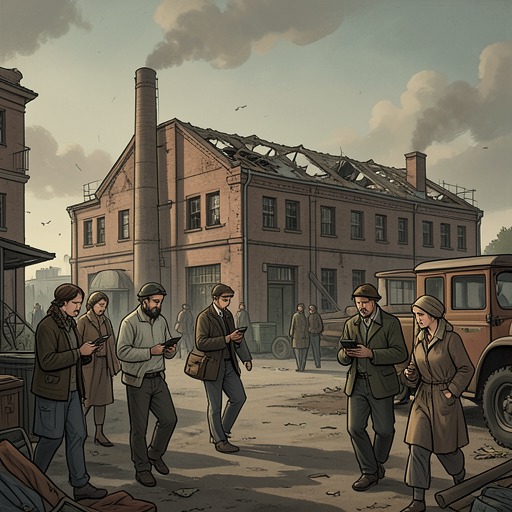
Baypen’s abandonment and post-fire condition
Clown in a CornfieldBaypen’s abandonment and post-fire condition make the factory a defining ruin in Kettle Springs: a once-working refinery that had already closed, then burned, but did not disappear. Its damaged shell remains visible across the cornfields, while the loss of its business is reflected in small changes to town life and in the unharvested fields beyond it. The factory is at once a landmark, a family inheritance, and a reminder that the town’s agricultural landscape depends on processing and buyers as well as crops.
The Factory in the Landscape
From the back lawn of her new home, Quinn Maybrook sees miles of corn, a landscape she recognizes as typical of Kettle Springs, where fields encircle the town. Beyond them, the factory breaks the horizon. Even at a distance, the building appears immense: Quinn estimates that it rises five stories, not counting a chimney stack that leans out from the rear. Its roof sags like a broken-backed animal, making the abandoned structure seem less like an intact workplace than a body left to decay.
The building’s condition is legible even before Quinn knows its history. A mural covers one side, but soot and grime have blackened it. Because Quinn associates murals with Philadelphia, she initially considers whether this one might offer a familiar reminder of home. Instead, the darkened surface directs her attention to the calamity that damaged the factory. She uses her phone camera’s digital zoom to inspect the wall and sees a clown painted there. The image gives the ruin a recognizable face before she learns that the clown is Frendo, Baypen’s mascot.
Closure and Fire
Ruston Vance explains that Baypen made corn syrup and that its refinery burned. His account is initially halting, and he calls the history a long story, leaving Quinn with only the broad outline. The chronology becomes clearer later: the factory closed before the fire, and the fire itself happened recently. Its closure, rather than the blaze, was the first rupture in the site’s working life.
At school, Janet Murray says that Cole Hill burned down the factory. Cole identifies it as his family’s factory, or at least his father’s, and says it had been empty for more than a year when the fire occurred. He calls setting it alight a mistake, but also describes the boarded-up building as slowly rotting and says he was not sorry it was gone. His response brings together personal responsibility and a broader rejection of the decayed past the building represents to him: he admits the act was wrong without expressing grief for the factory’s loss.
Janet corrects the idea that the factory was entirely gone. The interior had burned out, but the structure still stood. Cole revises his description to acknowledge that it was mostly gone, and Ronnie Queen points to the competence of Kettle Springs’ volunteer firefighters. The exchange distinguishes the destruction inside from the persistence of the exterior: the plant has lost its function and much of its substance, yet remains conspicuous in the landscape Quinn first observed from home.
The Factory’s Economic Afterlife
Baypen’s closure is present in ordinary conversation as well as in the visible ruin. Ruston mentions that a frozen-yogurt shop once existed but is gone since Baypen closed. He describes the Eureka Theater as one of the town’s remaining diversions, with mostly older films and occasional newer ones, while a trip to the mall requires driving to Jamestown, about twenty miles after reaching the highway. These details do not establish that Baypen alone supported every local business, but they place its shutdown alongside the contraction of available amenities and the distance separating Kettle Springs from larger-town options.
The fields also reveal a practical consequence of losing the refinery. When Quinn asks when the corn will be harvested, Janet answers that it will not be. Cole explains that a subsidy pays corn farmers when they plant, rather than when they harvest. Janet then links the unworked B-fields to Baypen’s absence as a buyer, asking whether clearing them is more trouble than it is worth without the factory and Cole’s father to sell to. Cole does not answer. The silence leaves the connection hanging: the crop continues to occupy the land, but the local processing outlet that once gave it an immediate destination is gone.
Ruin and the Blighted-Crop Image
Later, Sheriff George Dunne turns the surrounding fields into a political metaphor. As he explains his plan to Cole, he calls Cole and his friends a blighted crop and describes the farmer’s response to fungus or beetles: cut and cull, root out the problem, and burn a harvest if necessary so the land can recover. His language recasts young people as a threat to be eliminated and the town as ground that must be preserved. The speech takes place with dark cornfields on either side of the car, making agriculture more than scenery: it supplies the terms through which Dunne justifies violence.
Baypen’s ruined state sharpens the irony of that image without making the factory itself the cause of Dunne’s plan. A refinery that once converted corn into corn syrup has already ceased operating; its interior is burned out, its roof sags, and the crops around it can remain unharvested. Against that material history, Dunne’s promise to burn a crop in order to save the land sounds like a brutal version of restoration, not a return to productive life. The factory’s surviving shell and Frendo mural preserve the outline of a former local order even as the town’s fields and institutions register what its disappearance has left behind.